
Objects of Record

These are family heirlooms. Art, jewelry, tools. Things handed down to me, and things I asked to be the custodian of. These items are held in trust, not owned.

Every one of them has a story. The goal is to get that story recorded before it’s lost, so my descendants have it.

The photographs i take of these objects sit somewhere between product photography and personal portrait. It’s a deliberate choice.

The end result will be a printed catalog. Every item photographed, listed, and its history written down.


Elgin Wristwatch — James Gaughan

This is my grandfather, Detective Sergeant James Thomas “Bud” Gaughan, Indianapolis Police Department, badge 634. He was born in Indianapolis in 1912, played football for Cathedral, and married Kathryn Feeney at St. John’s in 1937. He joined the force in 1942 and made detective sergeant nine years later. He was killed in the line of duty on September 8, 1951, at thirty-eight, after nine years on the force. He left a wife and two children. My mother was only seven.

This was his watch. An Elgin, American made, late 1940s or early 1950s. I don’t yet know when he got it or how it came to him. That may turn out to matter. After he died it went to my grandmother Kathryn, who entered the Indianapolis Police Academy that same year and became an officer herself, later the first female Marion County deputy sheriff. It sat in her jewelry box for sixty-one years, longer than she was married to him. It came to me after her death in 2012.

This is as close as I get to him. The dial has aged, green has crept across it, and the case is worn in the way a watch gets worn. Apart from photographs, my family knows of only two things that survive him: this watch and his badge. It had no strap when it left my grandmother’s things. My dad had one put on before he gave it to me, so I could wear it, and I do now and then. It runs. It seems like the wrong thing to leave in a drawer.


Relide & Norman Wristwatches – Jacob Miller

Jacob Saul Miller was born in New York City on March 12, 1905, to Galician Jewish immigrants, and left for Indianapolis by 1924, where he practiced law the rest of his life. On April 9, 1941, at thirty-six and eight months ahead of Pearl Harbor, he enlisted at Fort Benjamin Harrison under no obligation to go; family account holds he volunteered because he wanted a part in the war against Nazi Germany. He married my grandmother, Kathryn Regina Feeney, in January 1966 and became my grandfather in every way that counted.

Sometime in the late 1970s, at his law office in downtown Indianapolis, he took two strapless watches out of his desk drawer, and we rode the elevator to another floor where the doors opened onto a watch repair shop. He clearly knew the man behind the counter. We picked out straps, he had the Norman watch (below) engraved with his name and Army serial number while it was there, and then he gave them both to me.

The dial reads RELIDE, WATERPROOF, INCABLOC, ANTIMAGNETIC, a Swiss watch of the 1940s or 1950s with painted numerals gone the color of old paper, and a case back stamped Stainless Steel Back that quietly admits the rest of the case is not. The crystal is heavily scratched and it will stay that way. There is no inscription anywhere on this object, and everything known about where it came from rests on the fact that I was there.

The second watch out of the drawer, and the one he chose to put his name on. The dial says NORMAN, and so does the movement, Norman Watch Co., seven jewels, unadjusted, Swiss. The case is stamped DURO, stainless, base metal. The silvering has gone dark and spotted across the whole face, there is a small seconds dial at six, and the plating is worn through to lighter metal at the corners of the lugs. The strap is the one we picked out that day and it is still on the watch.

He handed it across the counter and had it engraved while we waited. Jacob S. Miller, 35157344, U.S. Army. He enlisted under that number on April 9, 1941, and had it cut into the back of a watch some thirty-five years later, in front of a seven-year-old, on an ordinary afternoon with nobody else there. Whether he wore this watch during the war I do not know. He may have told me that day. I remember the room and not the words.


The Darkroom & Studio

After becoming a juried artist with HCAA, I did what I do best: recognize hidden potential in a space. This time it was the basement of HCAA’s Birdie Gallery.

I was down there for my day job, the one that actually pays the bills, checking out the building’s heating and cooling equipment. Tucked in the corner was an old porcelain-top kitchen sink. I looked closer and it was still plumbed in and functional. That’s when the gears started turning.

At the time the basement was just a catch-all: storage for things in rotation and things forgotten. I came up with a plan. Turn half of it into a darkroom and small studio, and keep the other half as storage HCAA still needed. I pitched it to the board expecting pushback. They gave me the green light instead.

I paid for the buildout myself and put in the sweat equity, clearing out and organizing the basement to make room. We ran a yard sale for the stuff nobody needed anymore. The support from the HCAA board and membership through all of it was genuinely inspiring.

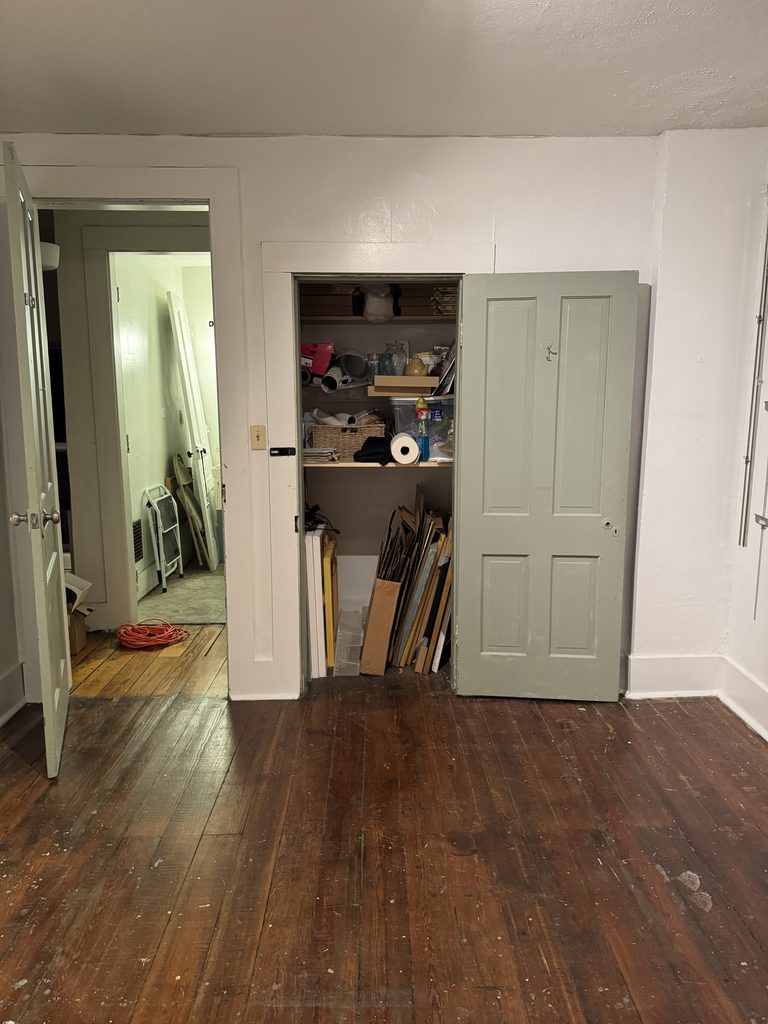
Before
Dad’s little cleaning helper
Dividing the basement

A few weeks of buildout later, I had a working darkroom with an attached studio. It’s served my own projects since, and it’s hosted more than that. My friend Dale Bernstein has ran wetplate portrait days and workshops there, and I’ve done hands-on darkroom demos for HCAA’s youth membership.

Dale Bernstein

Youth Members

Reverend Barney Stone

May 17, 1847 — November 20, 1942

Formerly Enslaved · Union Soldier · Educator · Minister

Most of what is written here comes from Stone’s own account, given to the Federal Writers’ Project in the late 1930s, and from a history compiled by many contributors.

Barney Stone was born into slavery on May 17, 1847, in Spencer County, Kentucky, on a plantation owned by Lemuel Stone. His mother bore ten children, all enslaved; his father, Buck Grant, was enslaved on a neighboring farm and was permitted to visit only on weekends. As a boy, Stone watched his sister sold and taken away. Later he watched his mother and infant brother sold to a trader as well — he would not see his mother again for twenty-seven years.

Around 1863, as Union troops neared the plantation, Stone ran and hid, was found, and joined the Union Army rather than be shot for fleeing. He served roughly a year and eight months. By his own account he fought at Fort Wagner and Milliken’s Bend; other research on his service ties him to the 108th United States Colored Troops. White soldiers in his unit taught him to read and write — skills he did not have going in and would spend the rest of his life putting to use.

After the war he returned to Kentucky searching for the family that had been sold away, taught school to Black children for four years, and studied nights at a lawyer’s home. In 1868, at about twenty-one, he began preaching. Over the next seven decades he helped build seven churches across Kentucky, Tennessee, and Indiana, married Kate, and raised a family of eight children.

Because of growing hostility toward Black residents in Kentucky, Stone moved his family to Noblesville in the 1890s, settling on Pleasant Street. He pastored the First Baptist Church at Fifth and Cherry, served as a Hamilton County circuit court bailiff, chaplain of the local Grand Army of the Republic post, and a member of the Knights of Pythias, the I.O.O.F., and the Masonic Lodge. For years he led the Memorial Day prayers at Riverside Cemetery — by neighborhood memory, prayers that ran long.

In 1938, at ninety-one, he traveled to Gettysburg for the 75th anniversary of the battle and heard President Franklin Roosevelt speak — the only Civil War veteran from Hamilton County to make the trip. “When I stood on the same ground where Lincoln stood, where he delivered his great speech, I think it was the happiest moment of my life.”

Stone died on November 20th 1942 at ninety-five — the last Civil War veteran in Hamilton County, and by some accounts the last surviving Black Civil War veteran in the country. The Noblesville Ledger called his three-hour funeral service “perhaps the most remarkable ceremony ever… for a soldier or preacher ever witnessed in Noblesville.”

Ex-Slave, Life Story of Barney Stone

Around 1938, interviewer Robert C. Irvin recorded Stone’s account for the Federal Writers’ Project’s Slave Narrative Collection — published in 1941 as part of Slave Narratives: A Folk History of Slavery in the United States, Vol. V: Indiana. It is a public federal record, and Stone’s words carry it.

A note before you scroll through the pages below: what follows is Stone’s own account, in the original typewritten document. That source reflects the language of its era, including terms no longer in use; the editorializing of the white interviewer who recorded it is not repeated here, but readers who are sensitive to this history should know what follows before continuing.

Typewritten page 185 of Barney Stone's interview, titled Ex-Slave, Life Story of Barney Stone
Page 185
Typewritten page 186, beginning Barney Stone's account: My Life's Story
Page 186
Typewritten page 187, continuing Barney Stone's account
Page 187
Typewritten page 188, concluding Barney Stone's account
Page 188

← scroll through the original pages →

“While I was born in slavery, I never intended to die in slavery.”
— Told to the Indianapolis Recorder

“My Mammy was mother to ten children, all slaves… His master permitted him to visit my mother each week-end on our plantation.”
— On his parents, Federal Writers’ Project interview

“After those experiences of sixteen long years in hell, as a slave, I was very bitter against the white man, until after I ran away and joined the Union army.”
— On his escape, Federal Writers’ Project interview

“I have accomplished much good in this life and have raised a family of eight children. I love and am loyal to my country… I am in good health and still able to work, and I am thankful to my God and my country.”
— Closing his account, Federal Writers’ Project interview, at about age ninety-one

First Baptist Church

Founded in 1853 as the first Black Baptist congregation in Noblesville, the church building at 195 South 5th Street was completed in 1875 for between $640 and $653 — on what were then Amo and Brock Streets, on the eastern edge of Riverside Cemetery. Stone was one of six pastors named on its historical marker.

Current marker attached to the former church, now HCAA’s Birdie Gallery.
Photo: Betsy Reason

1873–1875
The church building is constructed at Fifth and Cherry, then Amo and Brock Streets, on land along the White River near Riverside Cemetery.

1942
Stone dies at ninety-five, the last Civil War veteran in Hamilton County, and is laid to rest at Riverside Cemetery, a short walk from the church he pastored.

You can find where he is laid to rest here: Riverside Cemetery Walking Tour

2006
The City of Noblesville grants the Hamilton County Artists’ Association a permanent lease on the former First Baptist Church. Restoration opens as the Hamilton County Art Center in April 2007.

2019
The Plum Prairie neighborhood — home to a growing African American community on Noblesville’s southwest side since the nineteenth century — is added to the National Register of Historic Places.

2025
On January 7, the City of Noblesville unveils interpretive signage honoring Stone and the Plum Prairie neighborhood at 8th and Pleasant, as part of the Reimagine Pleasant Street project.

The 2025 interpretive sign. Photo courtesy of Michael Williams, Indiana Historical Society, Noblesville Township Black Historical Collection; sign design, City of Noblesville / American Structurepoint.

Kept, and Corrected, by Hand

A typewritten HCAA history of the church, annotated by Bryan Glover of the Noblesville Diversity Coalition — the small corrections in red are their own act of care toward getting the story right.

History of the First Baptist Church, Hamilton County Artists’ Association archive. Annotations by Bryan Glover.

Sources

  • Federal Writers’ Project, Slave Narratives: A Folk History of Slavery in the United States, Vol. V: Indiana — Barney Stone, interviewed by Robert C. Irvin, District #2, Noblesville, Ind. (Washington: Library of Congress, 1941) — https://www.loc.gov/resource/mesn.050/?sp=191
  • Hamilton County Artists’ Association, History of the First Baptist Church (archival document, annotated)
  • City of Noblesville, Reverend Barney Stone interpretive marker, Reimagine Pleasant Street project (installed January 7, 2025)
  • First Baptist Church historical marker, 195 S. 5th Street
  • Hamilton East Public Library, “Two Degrees of Separation From Slavery”
  • The Reporter, Current in Noblesville, and WISH-TV coverage of the January 2025 signage unveiling

Compiled by Stop Bath Studio, Noblesville, Indiana.

Riverside Cemetery – Noblesville, Indiana

Riverside Cemetery sits along the White River, on land that was once part of William Conner’s farm. Sources disagree on exactly when it became a cemetery, one puts it at 1820, three years before Noblesville existed as a town, another puts it at 1827, with the earliest marked grave dated 1824. Either way, it’s the oldest ground in the county seat.

The river has always been the problem. On March 26, 1913, the White River broke its banks, cut Noblesville off from the rest of the county, and crested at 23.8 feet, a record that stood for 113 years. By 1867 the city had already given up trying to keep Riverside dry for good and built Crownland Cemetery on higher ground, but Riverside stayed where it was, and stayed vulnerable.

On August 15, 2026, the river broke that century-old record. It crested at 24.6 feet, nearly a foot above 1913, during what turned out to be a 1-in-1,000-year rain event. Around 170 residents evacuated. The USGS gauge that tracks the river here sits a few hundred feet from the cemetery gates.

At least fourteen Black Civil War veterans are buried here, alongside founders, judges, infants, and unmarked plots going back well over a century.

I have a personal stake in this ground. I’m a member of the Hamilton County Artists’ Association, and my darkroom and studio sit in the basement of HCAA’s Birdie Gallery, the old First Missionary Baptist Church, which shares a fence line with the cemetery’s eastern edge. I develop photographs a few dozen feet from where most of these people are buried.

This is a walking tour built from headstone research, GPS-mapped stops, and an ongoing project to photograph headstones of local and historical significance. Each stop is an attempt to hold still in front of something that’s usually just passed by.

Riverside Walking Tour

1. HCAA’s Birdie Gallery

The HCAA’s current home is the historic First Missionary Baptist Church. Located at the corner of 5th and Cherry Streets (formerly Amo and Brock Streets), on the eastern edge of the Riverside Cemetery along the White River, the church has a profound historical significance.

Historical records indicate that the church was started in 1873 and completed in 1875 at a cost of approximately $650.


2. Donte Jamal Whitworth (United States Marine)

Corporal Whitworth’s story is one of profound sacrifice. Killed in action in Iraq in 2009, he was laid to rest with the highest military honors. A Marine honor guard personally delivered his headstone, ensuring his memory and service were commemorated with the utmost respect.


3. Once Displaced Memorials

Time and nature have left their mark on the cemetery, creating a historical mystery that endured for decades. Floods displaced numerous grave markers, washing them from their original resting places and scattering them across the grounds. In an effort to preserve these remnants of the past, they were carefully set in concrete, arranged with the hope that someone might one day identify where they truly belonged. For years, these stones stood as silent witnesses to both the passage of time and the challenges of historical preservation, serving as a testament to the lives they once memorialized and the forces that had reshaped their final resting place.

However, this chapter of the cemetery’s history came to a close in 2022, the final year of an extensive restoration project. The displaced markers, which had long stood apart from their intended locations, were carefully removed and relocated. Though they no longer remain in their temporary setting, their history—and the efforts made to honor and preserve it—remains an important part of the cemetery’s legacy.


4. John Hoard (Union Soldier)

The headstone of John Hoard is unique because he is listed as a member of Company D of the 54th Massachusetts Regiment. What is a guy from Massachusetts doing in Noblesville, Indiana? Most likely, John Hoard had never stepped foot in Massachusetts prior to enlisting to fight. The 54th Massachusetts was made up of African American freemen and was the first colored unit in the Federal Army.

Most people know about Abraham Lincoln’s Emancipation Proclamation. This executive order declared that any slaves in states that were part of the rebellion were declared free. This took effect on January 1, 1863, and is seen as a key turning point in the war. What many people don’t realize is that Lincoln’s proclamation also allowed African Americans to take up arms and join the Union cause.

Here is how the Proclamation states it:

“And I further declare and make known, that such persons of suitable condition, will be received into the armed service of the United States to garrison forts, positions, stations, and other places, and to man vessels of all sorts in said service.”

This caused quite a stir throughout the Confederacy. Not only was Lincoln taking away their slaves, he was also arming them to fight against the boys of the South. The leaders of the Confederacy sent a message to Lincoln that they intended to execute any black man captured in service of the Union army. Lincoln sent a message back that for every such execution, he would order a captured Confederate prisoner to be executed. These strong words were cause for concern, but Lincoln was being pushed by northern abolitionists to form a new unit of the federal army – the U.S. Colored Troops. Among those abolitionists was Frederick Douglass.

Another of these abolitionists was the governor of Massachusetts, John Andrew. Andrew stepped up and declared he would raise the first colored regiment – the Massachusetts 54th. However, Massachusetts did not have enough freemen to fill the ranks, so national recruitment began and reached as far as Noblesville, Indiana. Douglass led the recruitment.

There was a concern in the north about sending black soldiers into battle. Given the strongly worded intentions of southern leaders, would black soldiers wilt during the heat of battle? All eyes were on the Massachusetts 54th as they were sent to South Carolina. In their most celebrated action, they led a charge against Fort Wagner in Charleston Harbor on July 18, 1863. The 54th successfully breached the fort, but under heavy fire and tremendous casualties, were eventually turned back. However, the men fought valiantly, and their bravery was the spark needed for Lincoln to establish the U.S. Colored Troops. One hundred eighty thousand African American men volunteered as soldiers to fill these ranks.

That brings us back, once again, to John Hoard, a volunteer soldier in Company D of the Massachusetts 54th. He was a member of that first regiment that opened the door for so many others. He died 21 years after the Massachusetts 54th led the charge on Fort Wagner and was laid to rest at Riverside Cemetery.
__________
This information was provided by Kevin Yaney. For more details, visit: http://www.civilwarveteranswalkingtour.com/


5. William Brown (Union Soldier)

A military marker provided by the U.S. government tells the story of Mr. Brown, a veteran who served in a segregated unit. This headstone represents a powerful reminder of historical challenges while highlighting the cemetery’s long-standing commitment to inclusivity. Riverside Cemetery was never segregated and has always welcomed burials from all members of the community.


6. Joseph Hampton (Union Soldier)

National Archives: https://catalog.archives.gov/id/57001890
NAID: 57001893 NAID File Unit: 57001890 Microform: M1824


7. Giger Children Memorial

An intriguing marker catches the eye, distinguished by its unusual design. The names of the Giger children are etched on the ends of this distinctive memorial, creating a poignant tribute to young lives.


8. William Garver (Judge, Colonel)

William Garver was a lawyer, judge, and state representative from Noblesville. He organized the 101st Indiana Volunteer Regiment in 1862 and served as its colonel until poor health forced his resignation about a year in. He returned to law, became judge in 1873, and later represented Hamilton and Tipton counties in the Indiana legislature.

His son, Dr. William Ray Garver, is buried nearby (stop 21). The younger Garver’s headstone reads simply: “Hosp. Corps. Sp. Am. War,” Spanish-American War service in the Army Medical Corps, one generation removed from his father’s regiment.


9. Samuel Lutz

Unique iron headstone


10. Old Reviewing Stand

Standing as a testament to historical commemoration, the old reviewing stand once served as a platform for Decoration Day speeches. Here, the names of all veterans buried in the cemetery were solemnly read, honoring their service and sacrifice.


11. Shoemaker Memorials

Prominent obelisks from the 1850s and 1860s rise from the landscape, offering a glimpse into the memorial practices of mid-19th century Noblesville. These monuments represent more than stone; they are enduring markers of local history and remembrance.


12. Conner and Finch Family Plot

The intertwined stories of local families come to life in this section. John Cogswell Conner, a Civil War veteran, is buried near his wife Alice Finch, daughter of Hiram Finch, an early prominent citizen of the area. The graves of the Conner family members are carefully grouped together, creating a familial narrative in stone.


13. Memorial in Tree

Nature’s slow embrace is captured in a headstone gradually surrounded by a growing tree. This remarkable sight demonstrates the gentle intersection of human memory and natural growth.


14. Barney Stone (Union Soldier)

Born a slave in 1847 in Spencer County, Kentucky, Stone’s life was extraordinary. His parents were unable to live together, as his father was a slave on a nearby farm. Together, they had ten children, all of whom were also enslaved.

After witnessing the brutal treatment of his mother and siblings, who were beaten and sold to other plantations, Barney ran away at the age of sixteen and joined the Union Army. It was during his military service that he learned to read and write, thanks to fellow soldiers. By age twenty-one, he was preaching sermons. He married at twenty-four and had five children.

When his daughter Beulah graduated from Noblesville High School and later attended college in Kentucky, Barney was deeply involved in the community. He served as a Circuit Court Bailiff and was a member of both the Knights of Pythias and the Masonic Lodge. He took great pride in his military service and led many Memorial Day services at two local cemeteries.

A staunch Republican, he held the right to vote in the highest regard. At eighty-five, he campaigned across the state for Herbert Hoover’s presidential campaign. At ninety-one, he traveled to Gettysburg to hear President Franklin Roosevelt speak. He was the only Civil War veteran from Hamilton County who made the trip, and he later said, “When I stood on the same ground where Lincoln stood, where he delivered his great speech, I think it was the happiest moment of my life.”

Barney lived to be ninety-five, becoming the last surviving Civil War veteran in Hamilton County and possibly the last African-American Civil War veteran in the United States. His funeral, held at the church, lasted three hours to allow everyone to honor his extraordinary life.


15. Christy Crawford (US Mexican War Soldier)

A veteran of the Mexican-American War, one of the earlier conflicts represented among Riverside’s veteran burials. Full history pending research.
__________
This information was provided by Kevin Yaney. For more details, visit: http://www.civilwarveteranswalkingtour.com/


16. George Dale (Revolutionary War Patriot)

George Dale was born about 1754 in Virginia, British Colonial America and died in 1833 in Noblesville and is believed to be buried somewhere in Riverside Cemetery.


17. Archibald Ferguson

Archibald Ferguson wasn’t a soldier. He was a civilian, likely one of the merchants who followed the Union Army to keep it supplied. He was shot and killed in Murfreesboro, Tennessee, on March 26, 1863, near the site of the Battle of Stones River, at the age of 46 years, 6 months, and 4 days.

What happened next is the real story. Soldiers killed in the field were buried where they fell, dug up after the war, and reinterred in a military cemetery nearby. They didn’t go home. Ferguson did. Moving a body across a war zone took money, or connections, or both. His stone is more elaborate than most around it. That’s not a coincidence.


18. Sarah Victoria Evans

Full history pending research.
__________
This information was provided by Kevin Yaney. For more details, visit: http://www.civilwarveteranswalkingtour.com/


19. Babyland

West of the veterans memorial lies a section set aside for infant burials. Though records indicate approximately 18 burials, only six graves are currently marked. The city has plans to honor these young lives by marking the section’s boundaries and creating a plaque commemorating the infants buried here.


20. Veterans Memorial

A powerful tribute stands to honor veterans from eleven different wars buried within the cemetery. During Memorial Day and Veterans Day, American flags are placed on all veterans’ graves, ensuring their service is never forgotten.


21. Dr. William Ray Garver (Spanish-American War)

Dr. William Ray Garver (1854–1944) was the son of Judge William Garver (stop 8). Born in Noblesville, he studied at Butler University before earning his M.D. at Ohio Medical College in Cincinnati. He served as a physician in the Army Medical Corps during the Spanish-American War. His headstone reads simply: “Hosp. Corps. Sp. Am. War.” He is buried at Riverside on the Garver family plot. Exact grave location to be confirmed.


Noblesville Creates Campus

Move in day

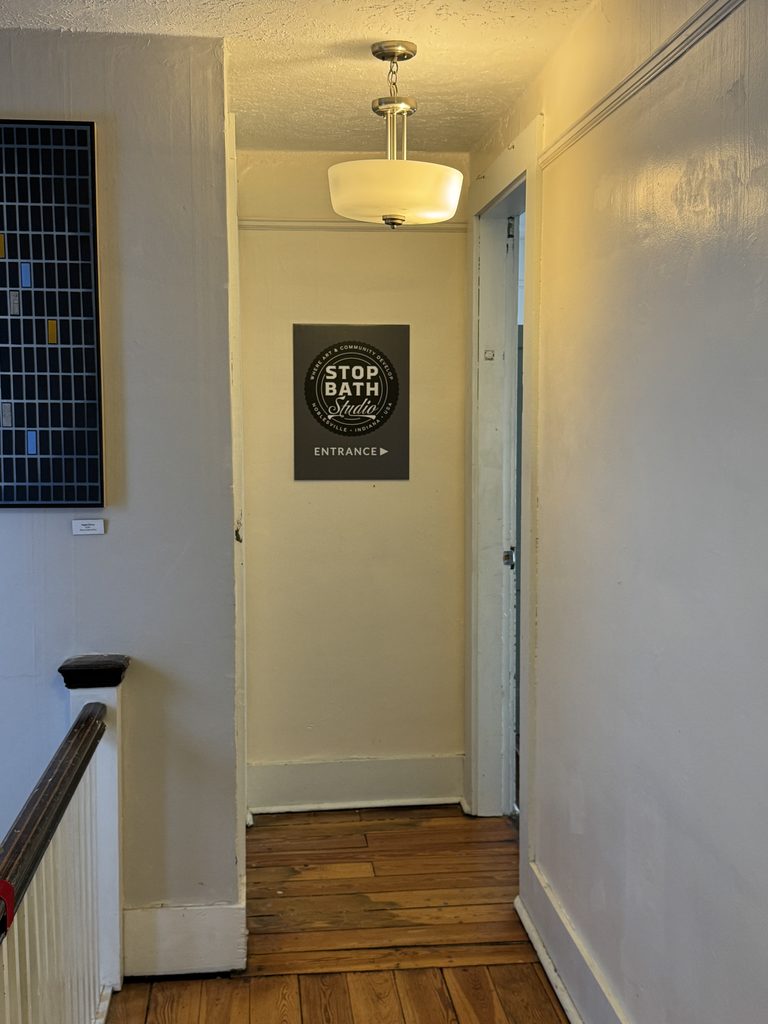
This space was never meant to be where the work gets made.

I used to think one room had to do everything: shoot, process, show, store. That’s a tempting kind of efficiency until you actually try it. Public access and wet darkroom work don’t share a room well. Working light and gallery light don’t either. Every function you stack into one space is another function you can’t fully control.

So I split it apart instead.

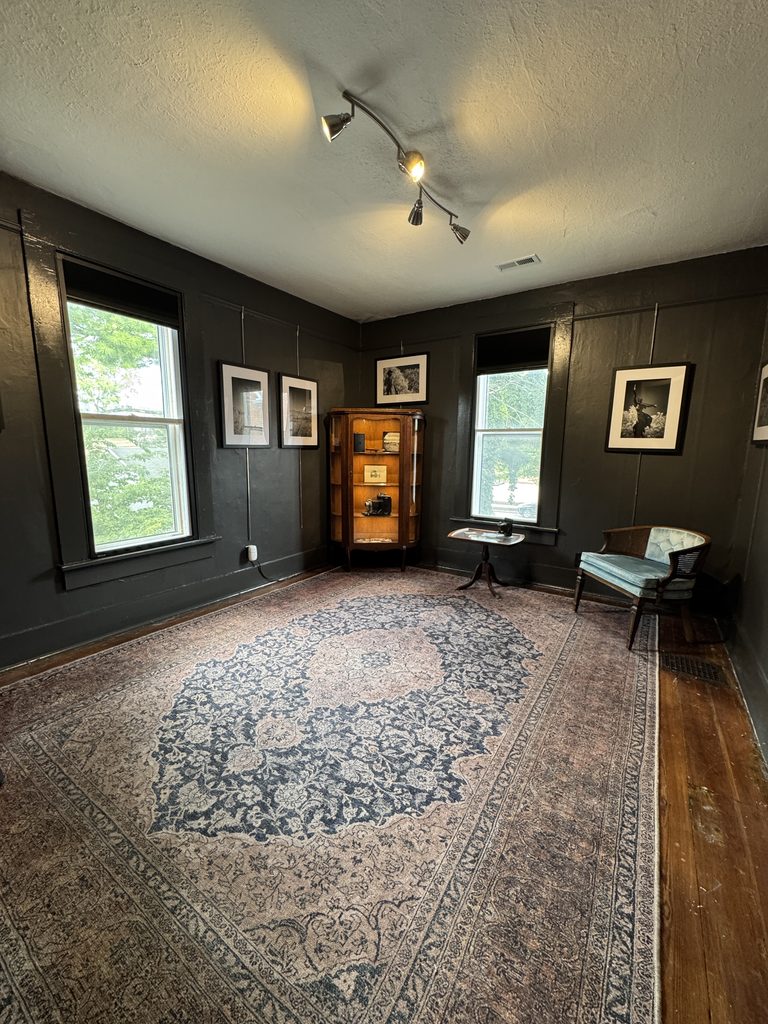
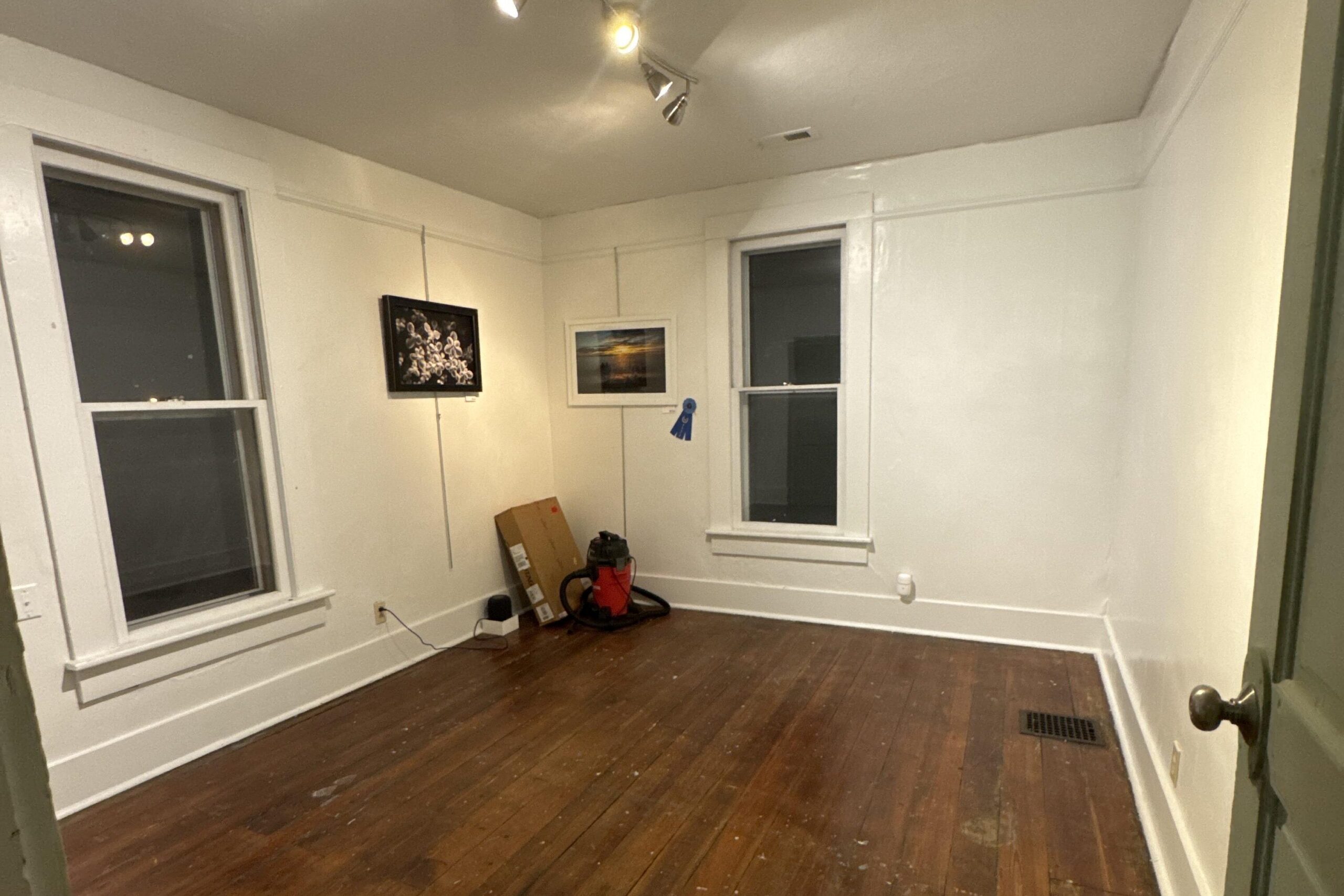
The darkroom and studio live in the basement of the Hamilton County Artist Association’s basement where the actual work happens: sessions, processing, the parts that need real control and don’t need an audience. This space, on the Noblesville Creates campus, has one job. Show the work once it’s finished.

I didn’t build a working studio here. I built a room that stays open, stays curated, and lets people walk in without an appointment or an explanation. Everything here exists to be looked at, not worked around.

That split is the whole point. The darkroom and studio in the HCAA basement carries the weight of making something. This space just has to let people see it, without me having to stand there narrating what they’re looking at.

If you want to see the work, it’s already hanging. Come take a look!
The Gettysburg Session

Gettysburg was part of a family trip, not a dedicated photography expedition. I knew I wanted to document it, but I also knew there wasn’t much to actually document. A lot of open fields, monuments, and stories. It’s hard to photograph a place like that without just making snapshots of monuments and fields.

I thought infrared might be a respectful way to bring some of that weight into the frame without over-explaining it. We were on the self-guided driving tour, and I wasn’t feeling much inspiration until I did. Then I had fun with it while still keeping the family exploration angle intact.

The result is The Gettysburg Session. 11 images, now physically up in my gallery!

The Model – Stop Bath Bettie

Meet Bettie, official studio mascot and permanent model. She’s a plaster bust who lives on a shelf in the studio and doesn’t say much about it.

Bettie exists because someone has to sit under the lights while I figure out what a new setup actually does. She doesn’t ask for direction, doesn’t need a break between takes, and has never once complained about a bad angle (despite there being many).

From here on, this is just her. Different lights, different lenses, different cameras. No story, no explanation, just Bettie.

History in Focus

My great-grandfather’s 4×5 Kodak field camera
My modern 4×5 Toyo field camera mounted with my great-grandfathers lens

My exhibit, History in Focus, set out to document Noblesville’s older homes and commercial buildings using my great-grandfather’s 1902 Bausch & Lomb lens on a 4×5 field camera. Each image was made on Ilford Direct Positive Paper, creating a single, one-of-a-kind print. I wanted the project to show the town’s quiet character through a slower and more deliberate way of working.

It did not go exactly as planned. I learned that the paper demanded full, direct light. Anything less left the image dull or unusable. What began as a search for subjects I found interesting became a search for subjects that were both interesting and fully exposed. My original vision was not fully realized, but the process taught me a lot about the lens, the limits of the material, and the patience it required.

The Birdie Gallery darkroom became an essential part of the project. Every print was developed there, and that space gave me the consistency and control I needed to understand how the paper reacted. It also became a quiet place to slow down, review mistakes, and start over.

Even with its shortcomings, the project felt connected to something larger. Using my great-grandfather’s lens more than a century later tied his craft to mine. I also enjoyed the hunt for vintage frames that matched the age and tone of each print. In the end, History in Focus taught me more about process than outcome, and that was enough.